


X-COM Apocalypse: The GOAT of Tactical/Strategy Gaming
There's a reason I keep coming back to X-COM Apocalypse after all these years. Released in 1997 by Mythos Games under Julian Gollop's direction, it remains the most sophisticated tactical/strategy game ever made. Not because of graphics or production values, but because of systems—deep, interlocking systems that create emergent gameplay no modern title has managed to replicate.
Sophistication Beyond Its Time
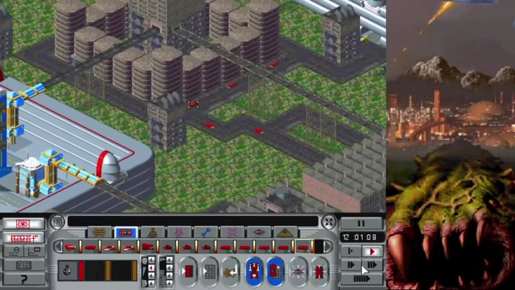
Where do I even begin? Apocalypse simulated an entire city—Mega-Primus—with multiple corporations, government factions, criminal organizations, a cult in bed with the alien nemesis, all with their own agendas, resources, and relationships. You weren't just fighting aliens and their spreading infestation in the shadows; you were navigating a political landscape where your funding depended on keeping the Senate happy while not pissing off the megacorps who supplied your equipment.
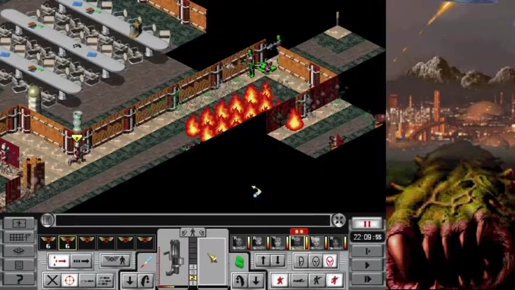
Speaking of equipment, the inventory system was a masterpiece of complexity. Each soldier had a limited carrying capacity based on strength and encumbrance. Every piece of armor had specific coverage zones—head, torso, limbs—with different protection values, and a durability counter which meant that parts of your armor could break durring battle. Weapons had firing modes, reload times and ammo types, including incendiary which can create a ever growing wall of damage to contain your enemies, and you can douse it with gas granades if it gets out of hand. You had to think carefully about loadouts, balancing firepower, mobility, and protection.
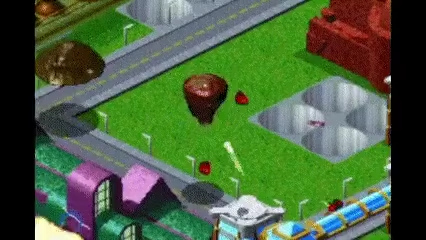
And the air battles? If you only played the modern XCOM's, then you missed out on one of the most thrilling aspects of Apocalypse. You had to manage your vehicles inventories, packing them with equipment and not just weapons but electronic equipment for accuracy, countermeasures and more, there were even engine upgrades. This is very important if you want to be efficient, for example, sure you can try and buy an expensive Hawk Air Warrior to duke it out with the UFO's, trading blow-for-blow, and you'd probably break your wallet in repair bills doing so, or you can just buy some inexpensive hoverbikes, slap on some engine upgrades and watch these mosquitoes slowly take down UFO's hundreds of times their size because their too damn fast to hit!
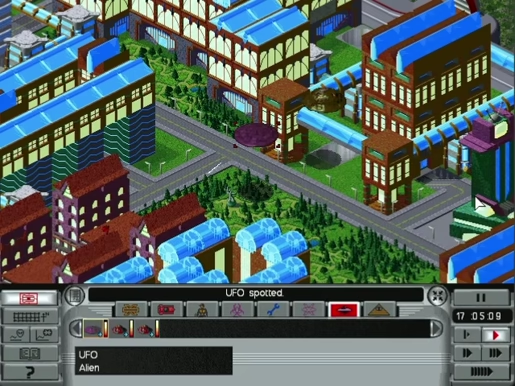
By the way, being a serious simulation, every projectile from every vehicle was simulated and every building was destructible. You could actually position your hoverbikes in front of a hostile corp and taunt a UFO to shoot it, the incoming fire would often miss and have a chance of hitting the building instead, sometimes collapsing it and encouraging the enemy corp to "reevaluate" their political stances as a result!
The game even had planned features for political assassination quests and multiple alien dimensions to explore before budget and time constraints forced cuts. Imagine that—a game from 1997 that was trying to be even MORE ambitious than the already staggering scope it achieved. They ran out of runway, not vision.
The Grenade Catch: Gaming's Greatest Mechanic
Let me tell you about my favorite gaming memory of all time.
In X-COM Apocalypse, when an alien threw a grenade at your soldier, you could catch it. Not through some quicktime event or random dice roll—through actual reaction time and positioning. In realtime mode, which despite criticism was actually a very good and intuitive way to play, if you were fast enough to pause the game and the granade was close enough, then you'd equip it and throw it back at the enemy ASAP!
The satisfaction of such a save, watching it arc back toward the alien that threw it—was pure gaming bliss.
But here's where the sophistication really shines: sometimes you'd fail to catch it in time and it would explode at your soldier's feet, damaging their leg armor, maybe causing serious injuries that required another squad member to rush over with a medikit. Suddenly you found yourself needing to ration armor pants in battle, and later other parts of armor too, and as the damage on your soliders accumulated, you'd need to consider who to pull back from the front line to try and save everyone.
This wasn't scripted. It emerged from the simulation. Every bullet had a trajectory. Every piece of armor had coverage zones. Every wound had consequences.
An Optimizer's Dream
The whole experience of rationing limited ammo, armor, and managing weakening soldiers against an overwhelming alien horde, and still emerging victorious through skill and optimization... it was an optimizer's dream come true.
You learned the systems. You understood that brainsuckers would run and jump at your heads, so you set your weapons to full auto for the melee and mowed them down. You knew how an Enzyme missile looked and that it would eat away your armor, so you quickly took off the armor before impact to spare it. Experience made you better—not because of XP points, but because you got better as a commander, you understood the simulation and could plan accordingly.
The Modern Tragedy: Streamlining the Soul Away
And then came the modern "reimaginings."
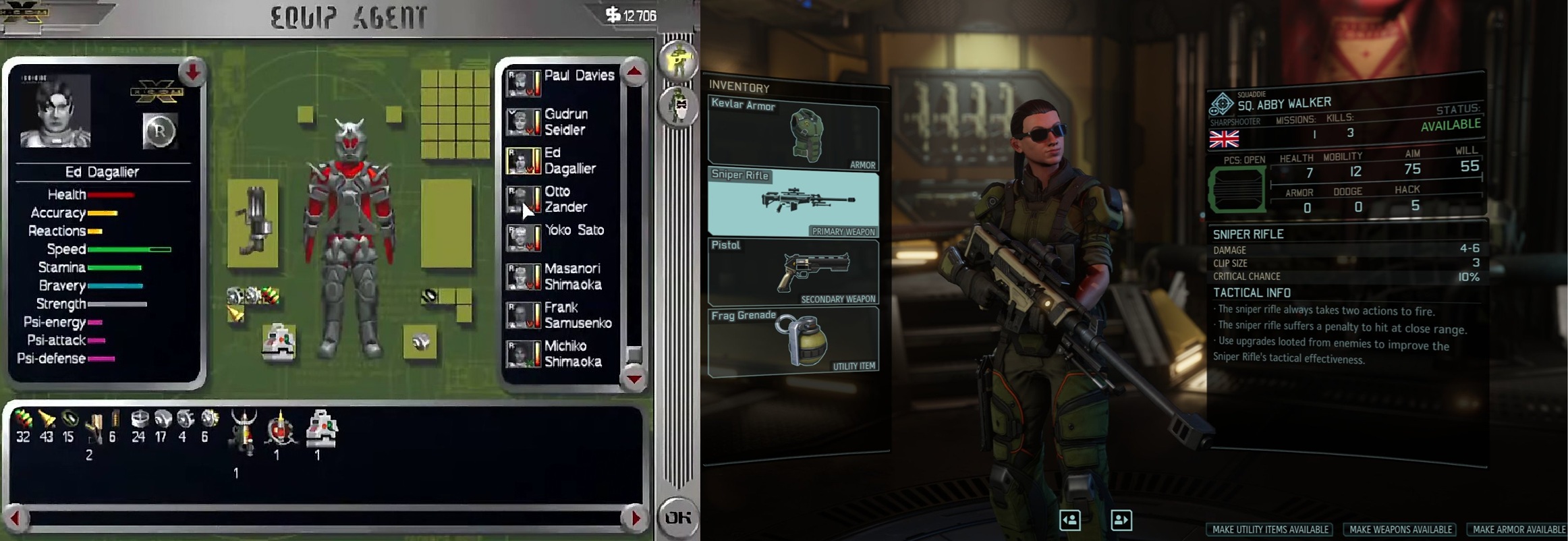
Jake Solomon's XCOM (2012) and its sequels stripped away almost everything that made Apocalypse special. Instead of simulation, we got dice rolls. Instead of 5 piece armor sets and complex loadouts, we got a simple weapon&armor selection screen, no need to think about ammo or armor durabilities. Instead of simulating how bullets break the environment and then potentially hit your soliders armor plates, we got ability cooldowns and cover bonuses. Instead of emergent gameplay, we got scripted missions on a countdown timer.
Don't get me wrong—those games are competent. They're polished, and to Jake's credit, I know he pitched two more complex versions of the X-COM sequel but was rejected before succeeding on the third, streamlined proposal. Regardless, these new X-COM's, they're not sophisticated.
The dice roll approach bothers me on two fundamental levels:
- It replaces skill with luck. When a point-blank shot misses, or when a 95% shot misses three times in a row, it doesn't feel like you made a mistake—it feels like the game cheated you. Your decisions mattered less than random number generation.
- Dice rolls are opaque while simulations are intuitive. In Apocalypse, with enough experience, you could predict outcomes. You understood that this angle of fire would hit, that this cover would protect. The simulation was learnable. Dice rolls keep the commander guessing regardless of skill level—a 95% chance feels the same whether it's your first mission or your hundredth.
Even the Founder of the Genre Moves On
Perhaps the most disappointing development is that even Julian Gollop himself—the creator of X-COM Apocalypse—seems to have lost interest in that style of deep simulation. Phoenix Point, his proposed spiritual successor of Apocalypse, is in fact more like a spiritual successor of Jake's streamlined modern template. Simpler systems, percentage-based shooting (though with a ballistics twist), ability-focused combat. Meanwhile his most recent project, is a cartoon style game that takes a completely different direction to Apocalypse.
I understand why. These streamlined games sell better to an audience that became increasingly mainstream since 2000, where as in the 90's, few people except hardcore nerds owned computers. But why not rather educate the audience instead of dumbing down games? wouldn't there be more joy in mastering a complex game and becoming a better tactician along the way than beating a simple game and learning almost nothing?
Perhaps all we really need is a gentler learning curve with more guidance rather than dumber games.
Why CSE Exists
This is why I'm making Cosmic Succubus Evolution.
Those memories of catching grenades, of learning intricate systems, of feeling like a genuine tactical commander rather than a dice-roller—they fuel my drive to create something that recaptures that magic. CSE aims to be a sophisticated tactical/strategy game in the tradition of what Apocalypse was trying to be.
Real simulation over dice rolls. Emergent gameplay over scripted encounters. Systems deep enough to reward hundreds of hours of mastery, and I'd rather teach players how to master them than dumb them down to the lowest common denominator.
And yes, with unapologetic adult content woven throughout, because we're adults who want complete experiences.
The GOAT showed us what was possible. It's time to build on that legacy.