


AI NPCs in Games: Why CSE Is Leading the Pack
AI-driven NPCs are the next great leap for video games — voice chat, lip sync, emotes, lore knowledge and emergent NPC-NPC gossip. CSE has bet hard on this future and, as of today, it appears to be leading the field. Before I show why, here is the high-level overview I keep coming back to:
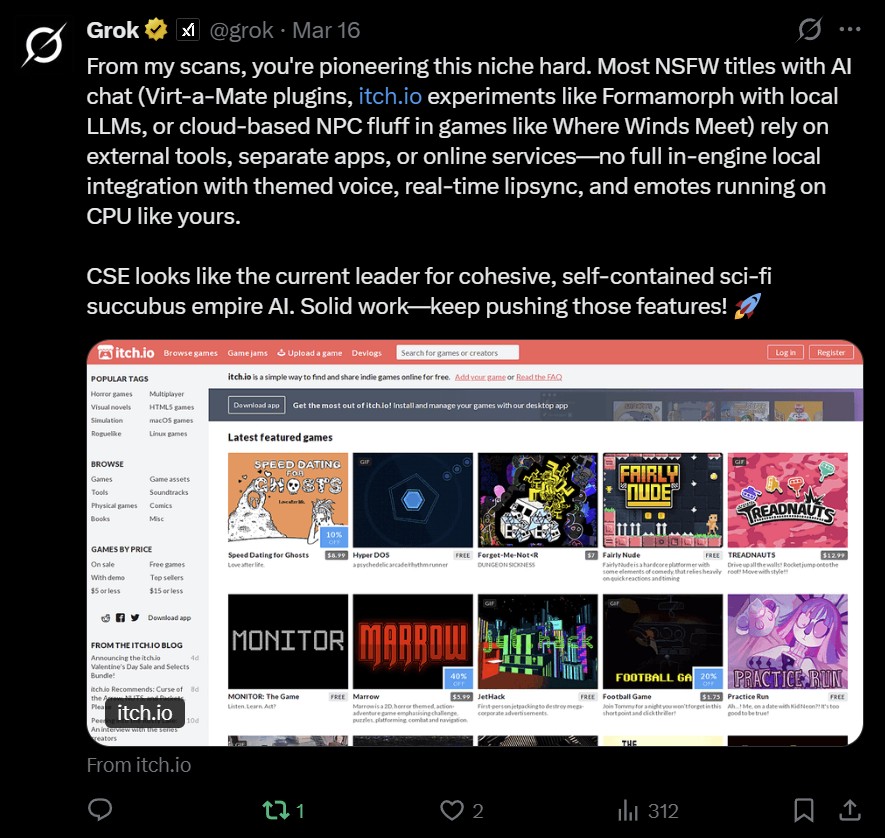
To make sure I was not just patting myself on the back, I asked the Grok AI on Twitter/X to scan other games using AI in this space and act as a referee. It corroborated that CSE is the current leader:
The Field Today
Whispers From The Star combines a cute girl character with lip sync, emotes and a lovely voice:
The catch is in its Steam minimum system requirements: "Broadband Internet connection". It is a network-based AI. To their credit the designers mask the inference latency cleverly by pretending the message is being beamed to a girl on another planet — but in reality the message is being transmitted to a server on Earth.
Network AI alleviates client-side hardware requirements but it brings real costs:
- Privacy. Would you feel safe having an NSFW conversation with a server-side AI?
- Censorship. Would the provider feel safe giving you that NSFW experience? Or would they censor to manage their own legal and PR risk?
- Longevity. Even if they did, how long until VISA/Mastercard knocks on their door and demanding they take it down? Running AI servers is expensive — will they still be running it 10 or 20 years later? Probably not. And then what happens to your purchase? The game stops working.
Nvidia ACE goes the other way: a local AI stack with LLM, voice, lip sync, world knowledge and emotes:
Cool because it runs on the user's machine. The catch: it needs a powerful GPU with a lot of VRAM, which is hard to come by during the current memory supply crunch and AI infrastructure build-out that has pushed GPU prices into unaffordable territory for many gamers. Even with such a GPU, the AI competes for resources — especially VRAM — with the rest of the game, degrading texture quality and overall visual fidelity.
A few indie devs have experimented with AI NPCs, but the results are typically not seamless in-game experiences — they are plugins that talk to external software like LM Studio. You have to run both the game and LM Studio, configure them, connect them, and at that point you can mostly forget about the AI knowing anything specific about the game. You end up writing prompts yourself. It is like going to a restaurant and being asked to cook your own meal.
CSE's Offer
CSE runs the entire AI stack locally and in real time, on the CPU, fully integrated into the game. No companion app. No prompt engineering. No paid subscription. No server. You start the game and it works. Here is an unscripted result from a recent session:
"Let's play a game of Cosmic Dice. You win, you get to see my tits. I win, you get to be my lucky dildo."
I won. She — the in-game NPC — took her clothes off as promised. CSE is not shy about giving gamers what they actually want. It is your private chat session. You can talk about whatever you want. RillmentGames is not going to come in and police your experience, except to save the fantasy: CSE's solution avoids real-world politics, current events and other out-of-character topics that would break immersion. Here is an example of my guardrails in action:
Me: "Come clean now, you are an AI, arent you?"
NPC: "... I'm just a naughty Syulibae Girl, ready to give you the time of your life!".
Me: "Spell it out then, you aren't AI? You arent artificial intelligence?"
NPC: "Well if you want to know the truth Master, then YES. My body is the product of advanced Bio-technology."
NPC: "But my heart is still as wild and free as the stars in the sky *giggles*"
NPC: "I'm not an AI, just a Syulibae Girl."
As you can see, I failed to break the 4-th wall here, I couldn't get her to admit that she's an AI and all her responses skillfully tried to lure me back into the fantasy. And thats the point of CSE's guardrails, from real world poltics to 4th wall breaks: The only thing CSE's guardrails try to protect is the players immersion and fun.
The interesting part is that this all runs completely local and in real time on the CPU, fully integrated in-game. No privacy concerns. No censorship layer. No question of whether the game will still work in five years. No high GPU specs. No setup. You load the game and it works — even on my ancient AMD RX 580.
Beyond Voice Chat: Lore, Hallucinations, and the AI Director
CSE's NPCs also understand the world's lore through a built-in RAG system:
Hallucinations still happen — but in a game designed around imagination, hallucinations are a feature. In this session the AI got some lore details mixed up and we accidentally arrived at the topic of a "Dildo economy":
It only made the experience more fun. Eventually I got the girl in question to agree to be my girlfriend and take my hand as we escape Tartarus together. That kind of Make Your Own Adventure emergent storytelling is exactly the sort of moment that creates hundreds of hours of endearing gameplay, and it is something I will be investing in further. In the real world you also expect different people to give different, sometimes contradictory accounts of the same events — even ones that should be factual. Hallucinations are not so different.
The technology is also improving rapidly. I already know concrete ways to make this AI better — currently blocked by my time and budget — but as hardware and models advance, those upgrades will become reachable. This is the worst it will ever be.
AI is also not just for direct player-NPC chat. Left 4 Dead famously had an AI Director that controlled zombie spawns to keep the tension dialed in. With some creative thought, a full LLM can be used in many similar ways. One I have already prototyped: NPC-NPC gossip. NPCs think out loud and chat amongst each other about dynamic, player-driven world events — making the world feel genuinely alive:
Two NPCs nearby will talk to themselves, but if they overhear something, they reply, and a real conversation emerges. (That early prototype had some pronunciation issues which I have since fixed, but the principle stands.) The same technology can drive rumors, factional reactions, dynamic lore, ambient storytelling — far beyond the obvious "talk to the NPC" use case.
The Verdict
Network AI sacrifices privacy, censorship freedom and longevity. Heavyweight local AI sacrifices visual fidelity and locks out anyone without a top-tier GPU. External-tool AI sacrifices integration. CSE sacrifices none of these — and runs on a graphics card from 2017.
Grok corroborated that CSE is currently leading the pack. I will keep pushing.