


Sci-Fi Physics That Could Actually Be Real: Diproton Stars, Black-Hole Goddesses & the Cosmic Succubus Universe
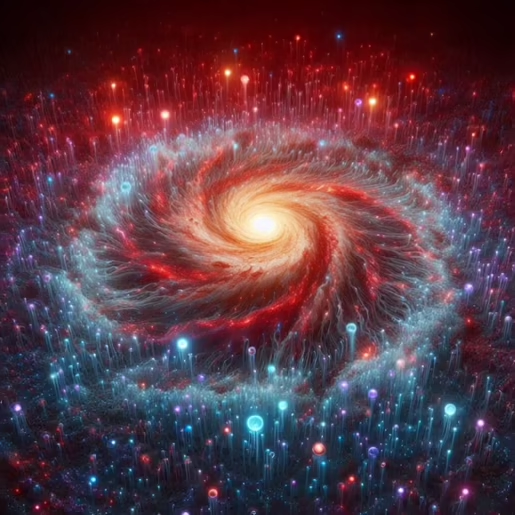
What if a single physical constant were slightly different? Not by orders of magnitude—just 2%. That's all it would take for the Diproton, a notoriously unstable isotope of helium with no neutrons, to become stable. If that happened, the entire universe would look fundamentally different. Stars would burn with altered colors, stellar lifetimes would shift, and the night sky itself would transform.
This isn't fantasy. This is real peer-reviewed science pondering on the multiverse, and it's the scientific grounding of the Jardenverse—the universe of Cosmic Succubus Evolution.
But thats not all, what if I told you there's a feasible link connecting our known universe to the fantasy of the Jardenverse? You see, there is serious scientific reasons to suspect that our universe is actually the interior of a gigantic blackhole, and while the topic of Singularities (blackhole interior) is poorly understood, in its conventional interpretation as a point of infinite density, it doesnt seem conducive to life. But, in the more recent Fuzzball interpretation of entangled cosmic strings, life just might thrive. And this is where I apply creative license.
If the interior of an entangled mess of cosmic strings can create conscious life, then it should not be far fetched to say this macro system itself can be alive, that is the blackhole is alive and it is our universe and her name is Neximeida and she lives in the Jardenverse, a universe containing our own, and it is her struggle with her cosmic sister that lead to the creation of what ancient humans thought were Succubi.
If your mind is blown at this point, then read on.
Part I: The Diproton — A Tiny Change That Reshapes the Cosmos
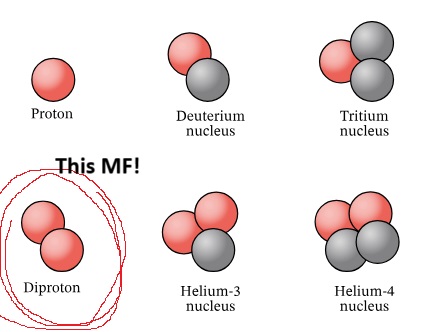
Isotopes are variations of atoms with different neutron counts. You've heard of Deuterium (one proton, one neutron) and Tritium (one proton, two neutrons)—these are isotopes of hydrogen. Helium typically comes as Helium-4 (two protons, two neutrons) or Helium-3 (two protons, one neutron).
Then there's the Diproton: Helium-2. Two protons, zero neutrons. In our universe, it's wildly unstable—it forms for a fleeting instant during stellar fusion and immediately decays back into hydrogen. The strong nuclear force in our universe is just barely too weak to to resist the electrostatic repulsion of two protons without a neutron mediating.
But what if it were about 2% stronger?
The Diproton would become stable. And that changes everything.
The Old (Wrong) Assumption
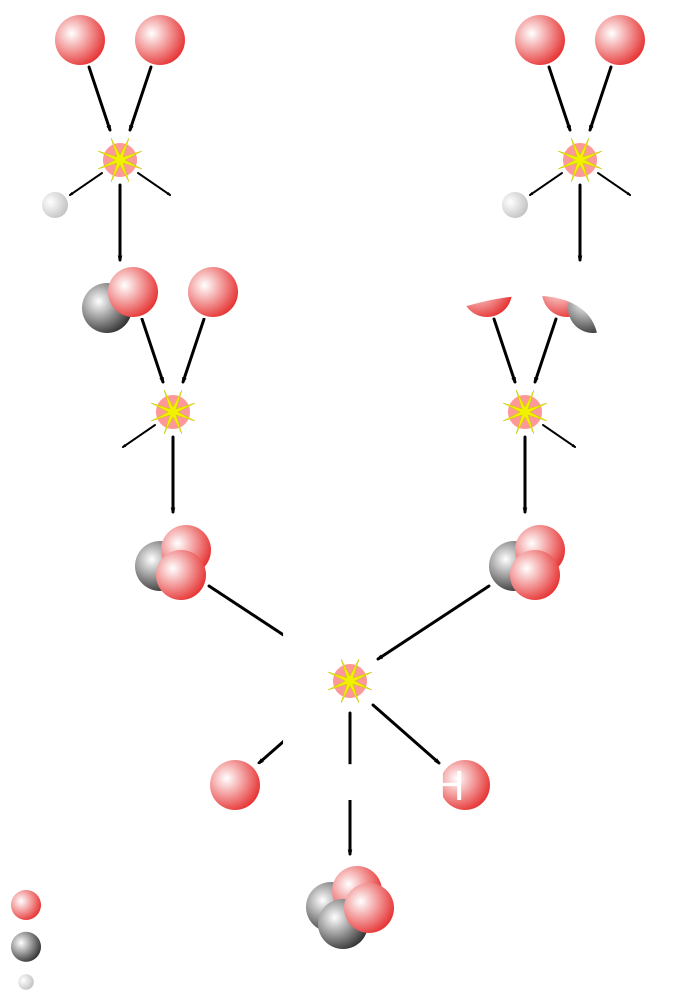
For years, physicists assumed a universe with stable diprotons would be catastrophic for complexity. The reasoning went like this: the Proton-Proton (PP) chain is the dominant stellar fuel cycle in stars up to about 1.3 solar masses, responsible for roughly 83% of our Sun's energy. In the PP chain, two protons fuse, and one must undergo inverse beta decay to become a neutron—forming deuterium. This is extremely slow because it requires the weak nuclear force, and that slowness is what regulates how fast stars burn.
If diprotons were stable, the thinking went, stars could skip that slow weak-force step entirely. Protons would fuse directly into stable diprotons, and the PP chain would accelerate by a factor of 1018. Stars would burn a quintillion times brighter, exhaust their fuel almost instantly, and the universe would be a sterile hellscape—no time for planets, chemistry, or life.
Why That's Wrong
Recent research showed this catastrophic picture is incorrect. The key insight is Coulombic repulsion—the electromagnetic force that makes protons repel each other. Even if two protons successfully fuse into a stable diproton, that diproton still carries a +2 charge. It electrostatically repels other protons even more strongly than individual protons repel each other, which actually discourages further fusion reactions involving the diproton.
But here's the elegant part: electrons carry a -1 charge. The diproton isn't repelled by electrons—it attracts them. Through electron capture, the diproton absorbs an electron, converting one of its protons into a neutron. This transmutes the diproton into deuterium, which then continues through the normal PP chain as usual.
The result? The overall stellar fuel cycle is altered, but not catastrophically. Stars behave differently, but they still function as long-lived thermonuclear furnaces capable of supporting complex chemistry and life.
What Diproton Stars Actually Look Like
The change of dynamics creates a universe with notable differences:
- Stars at roughly one-third the mass of our Sun undergo a dramatic spectral shift—they abruptly transition to light blue, and at a second threshold, to deep blue.
- Stars around the mass of our Sun are actually redder than what we observe.
- Stars generally burn somewhat brighter across the board.
- While stars do burn through their fuel a bit faster, they still hang around long enough to support the development of complex life.
- The smallest, most frugal stars can live as long as the oldest stars in our universe, with total expected lifetimes exceeding the current age of the cosmos.
A diproton universe isn't sterile—it's just different. Beautifully, measurably different.
This is the physics foundation of the Jardenverse. CSE's universe operates with a strong nuclear force roughly 2% stronger than ours. The stars are generally more red, a bit smaller on average, painting the galaxy in deeper warm tones—until you encounter the larger ones, which may rapidly transition to brilliant blue as their fuel cycle shifts to a different regime.
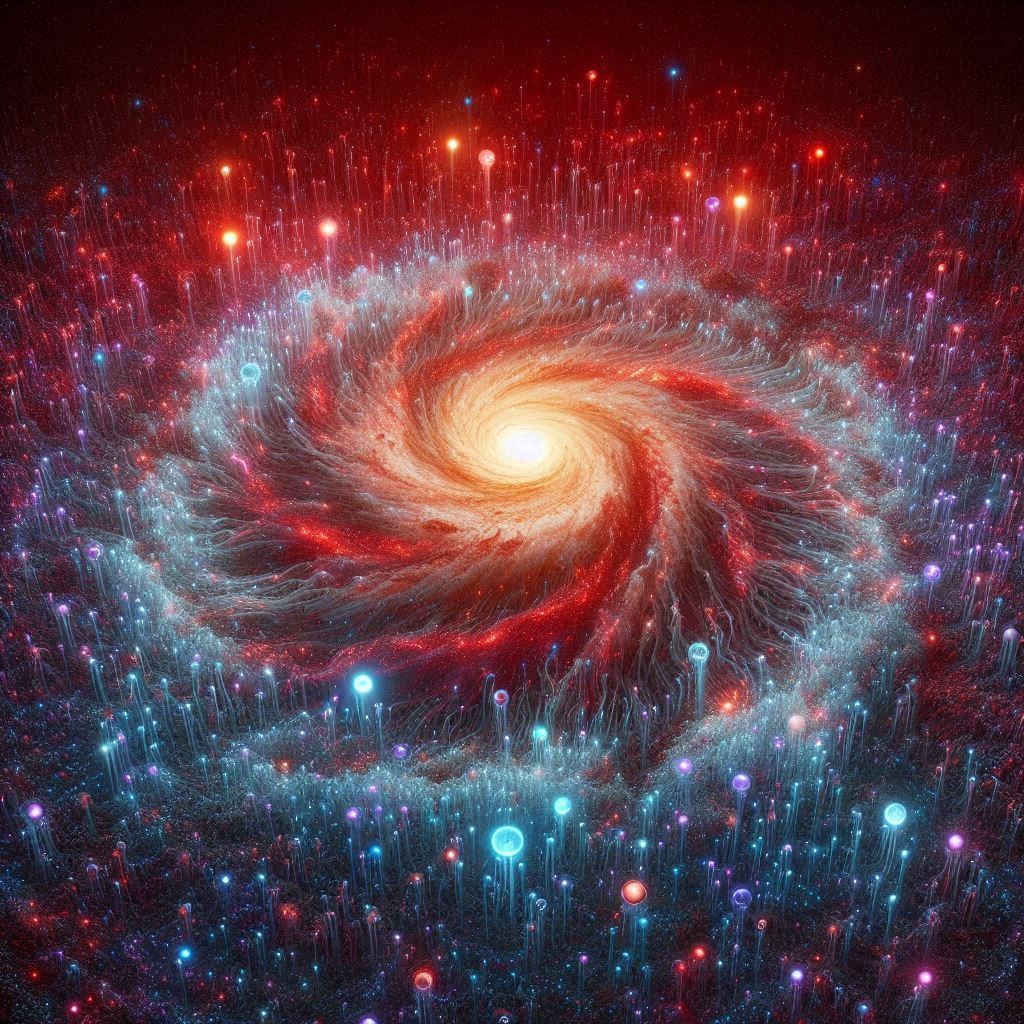
That's why the Jardenverse features more red stars than usual and thats grounded in actual peer-reviewed astrophysics. Although the full story flavours this scientific core with a fantasy of varying physics depending on region, which allows for a rich tapestry of cosmic phenomena and narratives.
Part II: Are We Living Inside a Black Hole?
Now let's zoom out. Way out. What is the universe itself?
Here's a remarkable coincidence—or maybe it isn't a coincidence at all. If you take the observable universe's estimated mass (around 1053 kg) and compute the Schwarzschild radius for that mass, you get a number suspiciously close to the observable universe's actual radius (~46 billion light-years). The mass-to-radius ratio of our universe matches what you'd expect of a black hole.
Galaxy rotation patterns add another data point. The way galaxies spin, the distribution of angular momentum—some researchers argue these patterns are consistent with what you'd expect inside a black hole's interior.
This is the basis of the "universe as black hole" hypothesis, explored by physicists like Lee Smolin (cosmological natural selection) and Nikodem Poplawski (torsion-based cosmology). It's not fringe anymore—it's a legitimate theoretical framework.
Fuzzballs: Black Holes Without Singularities
But here's where it gets really interesting. Classical general relativity says black holes contain a singularity—a point of infinite density where physics breaks down. That's... unsatisfying, to put it mildly.
String theory offers an alternative: the Fuzzball conjecture, proposed by Samir Mathur. Instead of a point singularity surrounded by an event horizon, a black hole is actually a fuzzball—a tangled, horizon-sized ball of strings and branes. No singularity. No event horizon in the traditional sense. Just an incredibly dense quantum object.
And these strings? They become quantum entangled with each other. Like cosmic spaghetti, pulling one strand affects all the others. This web of entanglement is, according to some interpretations (particularly the ER=EPR conjecture from Maldacena and Susskind), how the "illusion" of spacetime itself emerges. Space isn't fundamental—it's an emergent property of quantum entanglement between strings.
So if our universe is a black hole, and black holes are fuzzballs of entangled strings, then we are living inside a web of quantum entanglement that generates the spacetime we experience.
Part III: Neximeida — The Black-Hole Goddess
This is where science meets story.
In Cosmic Succubus Evolution, the Jardenverse operates on the premise that universes can exist inside black holes—a concept inspired by fecund cosmology. Our universe, the one you and I inhabit, exists inside a black hole named Neximeida.
Neximeida isn't just a black hole. She's a sentient cosmic entity—a goddess. A Celesquar, ancient sentient stars, beings of incomprehensible power, but she went beyond that and became the first celesquar to keep her mind intact after becoming a blackhole, and in that moment of her transformation, our universe was born, this is something that will contribute the CSE's grander cosmic drama.
You see, Neximeida had a spat with others of her kind and was thrown out of Jardenverse core, a place their mythology calls "Heaven". After meeting the wrong type of celestial entity on the intreversible edges of the Jardenverse, Neximeida got the idea to fight her way back into heaven and get her way. To do this Neximeida created an army of horned, winged, bio-adaptable, astrally-gifted, all female beings which look like what someone from earth might call a Succubus. Actully, whats to say that ancient earth lore was not inpired by the visits of beings from other worlds? In the CSE story, The Syulibae, as they are properly called did briefly visit ancient earth and Neximeida has a need for the souls of exceptional human men to lead her army, and this is how the legend of the Succubus was born, tying the folklore and science together in a cosmic tapestry of myth and reality.
The Magic of Sci-Fi: Where "What If" Lives
This is what separates science fiction from pure fantasy.
With fantasy, we can confidently assert that the story can't possibly happen in the real world. Dragons, magic spells, enchanted swords—wonderful fantasies, but we know with certainty they they are just that.
But proper research-grounded sci-fi? That's different. The diproton physics in the Jardenverse are based on a real peer-reviewed paper. The black-hole cosmology draws from legitimate theoretical frameworks being actively researched by physicists. The fuzzball conjecture is a real proposal in string theory. Fecund cosmology is a real hypothesis.
You cannot definitively say "this could never happen." And that plausibility is magic.
That's where imagination truly lives—in the space between known and unknown, where one thinks "what if..." and the universe doesn't immediately say no. Where the laws of physics, as we understand them, leave the door open for the extraordinary.
The Jardenverse isn't just a game setting. It's a thought experiment wearing the clothes of a cosmic succubus opera. And the best part? It just might be real.