


Killing Micromanagement Hell: A Mobile Asteroid Base + The Threat Response Mechanic
Grand strategy and 4X games like Civilization, Stellaris and their kin are notorious for one thing: late-game micromanagement hell. The early game feels epic, but as your empire balloons across the map you stop being a ruler and start being a clerk—queueing buildings in dozens of cities, marshalling units across continents, babysitting idle colonies. The fun evaporates and players quit, often while winning.
The Universal Complaint
Across Steam, Reddit, CivFanatics and design essays, the consensus is brutal:
- Cities and production explode. Late-game Civ empires have 15 to 30+ cities. Half of them don't even need attention but you cycle through them every turn anyway, queueing buildings, assigning governors, tweaking tile improvements. Turns that took seconds stretch into minutes.
- Unit marshaling becomes soul-crushing. Reinforcing a front from production hubs on the other side of the map is dozens of turns of pure tedium. Civ VII tried to address this with commanders. Earlier entries are infamous for it.
- Late-game drag. The game snowballs faster than the interface can handle. Exponential growth—more pops, more units, more events—collides with tools that were designed for small empires. People quit when they're clearly winning because mopping up feels like grinding rather than triumph.
Stellaris leaned hard into automation: planet designations, sector AI, governors. Player reception is notoriously mixed—the AI overbuilds housing, ignores empire-wide needs, leaves pops unemployed, occasionally tanks your economy. Wide players still end up manually checking everything. Paradox keeps patching it but the fundamental tension remains: the game wants big empires, yet meaningful choices scale poorly.
A few games experiment with mobile bases as a way out. Stellaris is adding a "space nomads" arkship origin in Season 10. Stellar Reach has a Shipbuilders faction whose capital ships are fully mobile infrastructure. Distant Worlds is praised for letting you delegate almost everything. The design philosophy is shifting: instead of automating sprawl, make the base itself mobile so the player stays at the strategic level instead of the clerical one.
CSE goes all the way down that path.
Design Decision #1: Your Realm Is a Mobile Asteroid Colony
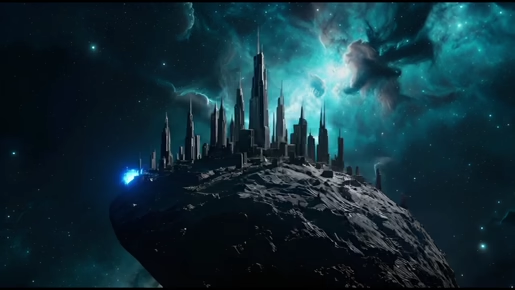
In CSE you do not have an empire. You have one base. That base is an asteroid colony—or, optionally, a small constellation of clumped asteroids that move together and function as one. It is a tiny living planet with skyscrapers on its surface, districts buried in its rock, and a warp drive bolted into its core.
When you engage the warp drive, bright blue exotic particles ooze out of the asteroid and condense into a propeller of light behind you, pushing the city forward with rising speed. You're not commanding fleets that ferry colonists to new worlds. You ARE the colony. The colony is what moves.
I want to be honest about where this idea came from. Mass Effect's Normandy is the seed. Having a mobile base that combines exploration, action, and a place to call home is genuinely fun—it's a huge part of why Mass Effect feels alive between missions. But the Normandy is limited as a base. It is a ship. It is small. It cannot truly be a city.
A flying city is the ideal version of that fantasy. Big city ship, lots to do, real population, real districts, real culture. Long warp recharge between jumps. And, critically, only ONE of them—because that is what kills the management nightmare at its source. There is no scattered empire to administer. There is no remote production hub to babysit. There is the city, the cosmos around it, and your decisions about where to take it next.
Design Decision #2: The Threat Response Mechanic
A mobile base alone is not enough. If you can sit still safely, players will sit still—optimize, turtle, build outposts, become a Civilization-style stationary empire by another name. I've played that game. It is boring.
So I built a mechanic specifically to defeat it.
You can build Outposts. They provide military and economic benefits. Bunkering down at a chokepoint, building defense outposts, fortifying a system—all of that is possible, and your first instinct as a strategy gamer will be to do exactly that. Hold ground. Stack defenses. Build the city.
Then the galaxy starts to notice you.
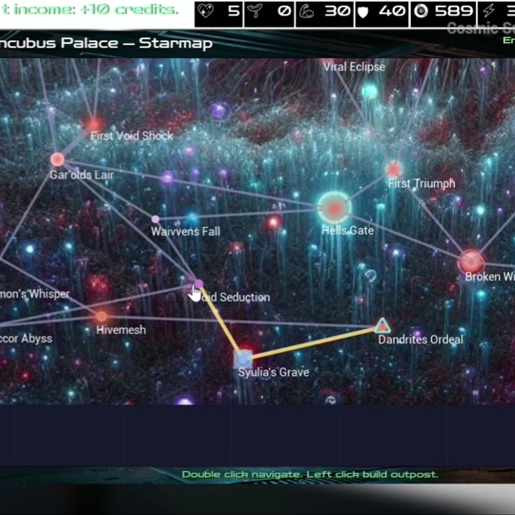
The longer you stay in one place, the more word of your whereabouts spreads. Hostile forces from across the galaxy begin converging on your location. Nearby star systems on your scanner shift slowly red as enemies accumulate. The magnitude of the threat keeps growing. And no matter how good your defenses are, you will eventually lose the attrition war—because your girls cannot breed and defend at the same time. Your population is finite. Your warp drive needs cooldown. The clock is always running.
Your only hope is to keep moving. Find a calmer pocket of the galaxy—a Nebula, a forgotten backwater—breed your population back up, refit, and move on before the heat catches up.
This is genius if I do say so myself, and not because of the mechanic in isolation but because of what it eliminates:
- It prevents stagnant empire-building because there is only one base and it is mobile.
- It prevents late-game micromanagement hell because there is no scattered empire to administer in the first place.
- It guarantees the action is always close to you. There are no fronts on the other side of the map. Your only city IS the front. When combat happens, it happens here.
- It gives the entire game a permanent "Under Siege" vibe that I find genuinely thrilling. You are never safe for long. You are never bored. You are never clicking through 25 idle cities.
The Chess Analogy
Motion is both necessary and risky. Think Chess.
Bad move? You're stuck defending for a week of in-game time until warp is ready again. Good move into a calm pocket? Congratulations—you have a week to immerse yourself, step out of the Starmap chamber, slow the game to interactive speed, and go flirt with a Waivven priestess. Breed a little. Build something. Repair. Train. It might be exactly what you need to survive what's coming.
(Yes, in CSE your population doesn't magically pop out of nowhere like in most games. You have to breed them yourself. Every Syulibae that crewed your last engagement is a girl you helped bring into existence. That stake is part of what makes the threat response mechanic bite.)
Tuning the Tempo
I won't pretend the design is solved. The current concern is that the action can be too exhausting—you always need to move while being mindful not to get trapped on the warp network between two larger forces, and you need to hurry to breed and build before enemies catch your scent.
The multi-speed design of the game already helps with this. You can slow time down inside calm pockets to immerse, and speed it up while traversing the warp network. Balancing the enemy response rate is the real tuning problem: how fast does the heat rise, how long are the calm pockets, how much breathing room does a typical player need between encounters.
I'm also considering terrain-specific effects. Nebulas could let you stay hidden longer—at the cost of some disadvantage like reduced sensor range or slower warp charge. Asteroid fields could provide cover but limit maneuver. Different parts of the galaxy would then have different risk-reward profiles instead of being uniformly dangerous.
Why This Matters for the Genre
Grand strategy is a beloved genre and it deserves better than the slow death by a thousand clicks that has become its hallmark. Stellaris ships imperfect automation. Civ VII trims builders and adds commanders. These are patches on a fundamental problem: the games are designed to grow until growth itself becomes the burden.
CSE's solution—mobile base plus a forced-nomad mechanic—is one possible escape from that trap. You stay strategic because there is nothing clerical to manage. You stay engaged because the threat is always rising. You stay invested because the one city you have is the only thing standing between you and the galaxy that wants you dead.
I think this is the way to make a modern grand strategy game that is actually fun to play to the end. No mid-game slog. No late-game spreadsheet. Just you, your asteroid, your girls, and a galaxy that won't leave you alone.