


Webstore and Agentic Feedback mining in CSE

Big changes have landed in CSE. First, the game now has an in-game shop for optional additional content such as cosmetic items and the NSFW game mode. More importantly, the game is now fully free. You no longer need a Patreon login just to unlock CSE.
That changes the shape of development. Instead of making the whole game sit behind a login gate, everyone can get in, play, test, report, and enjoy the core experience. Optional content can support the project without turning the front door into a toll booth.
The shop runs on our new in-game currency: GEMini.
GEMini: GEM + Twins

The name is exactly what it sounds like: GEM plus Twins. The currency is a gem, but the identity points at the twin-sister heart of the setting.

That twin imagery is, of course, a reference to our cosmic sister main characters: Renaludra / Rubiyiel and Neximeida / Saphryiel. They are not just pretty lore ornaments. They are part of the cosmic foundation of CSE, and GEMini lets the store system carry a little piece of that mythology instead of feeling like a generic premium coin bolted onto the side.

How To Get GEMini
In the future, you will be able to obtain GEMini through Patreon or SubscribeStar subscriptions. But I do not want to force you to pay real-world money to get the sexiest stuff in the game.
You can also earn a massive 5,000 GEMini by sharing the referral link in your profile page. This is 5,000 GEMini for every single person who joins through your link, so if you share it well, you stand to make a serious pile of GEMini. Even better, the person joining through your link also gets 2,500 GEMini. It is a Win-Win system by design.
Start from the profile page, sign in, and grab your referral link from your profile.
There is another way to obtain free GEMini: tell The Secretary.
The Secretary is an in-game AI, which is one of the perks of having local AI built directly into CSE. If you give a big report, idea, review, critique, bug report, or other valuable feedback, you can earn 100 GEMini. The point is simple: good feedback is work. If a player takes the time to explain what happened, why it mattered, and how the game could improve, that effort should be rewarded.
The Abuse Problem
Unfortunately, there is a real risk here. Some people will try to devalue the system by providing low-quality feedback that does not improve the game, clutters the pipeline, and devalues GEMini for everyone else.
That is a risk I accept because the upside is enormous. A direct, rewarded, in-game line of communication with players could be one of the most valuable tools CSE has. Players see pain points I miss. They discover exploits, confusion, balance problems, UX dead ends, and brilliant ideas from inside the actual play experience.
But accepting the risk does not mean doing nothing about it. To reduce abuse, CSE uses a clever agentic loop system. It seems we are once again on the forefront of innovation, but I also believe systems like this will become common in the future. So for the greater good, and for the technically curious, here is how it works.
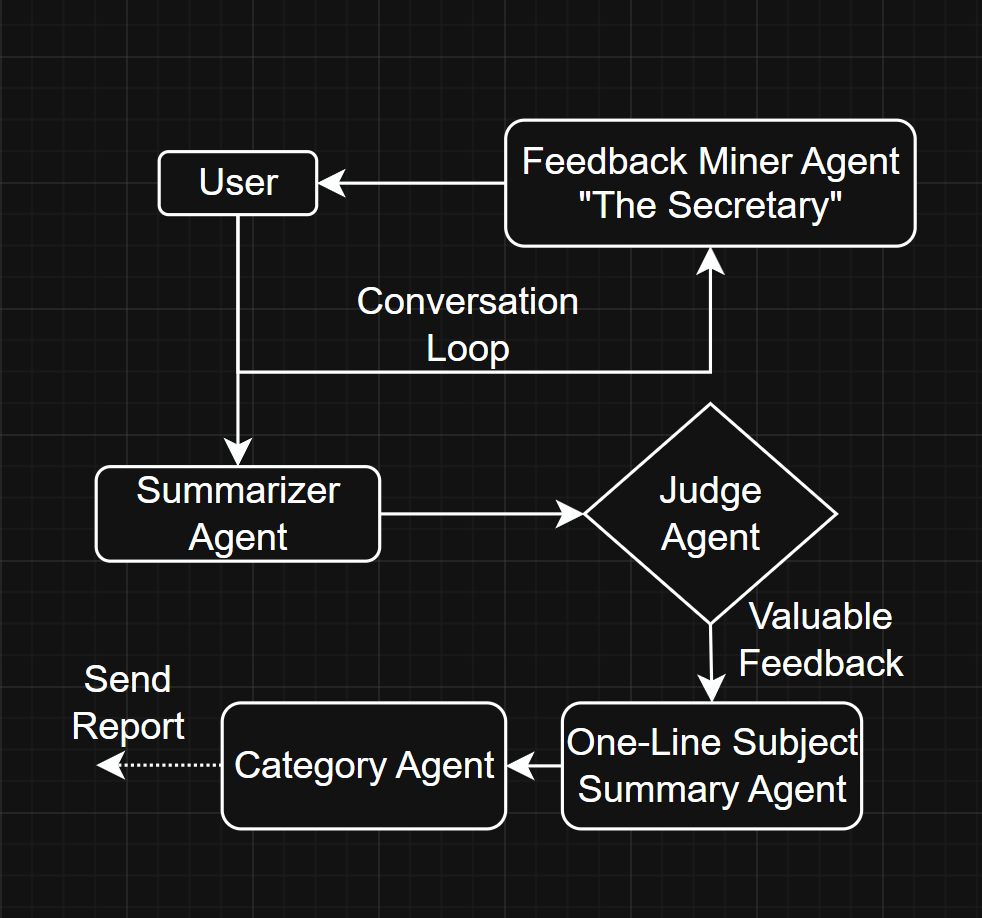
Step 1: The Secretary Mines The Conversation
Just because a user wrote something does not mean it is actionable or useful.
So The Secretary does not merely receive a blob of text and shove it into our system. She engages the player with follow-up questions that try to tease out the details of the issue and steer the conversation toward something that can produce valuable feedback.
This can continue for several rounds in a multi-turn conversation. If the player says "combat feels bad," The Secretary can ask what enemy type, what build, what part felt unfair, what they expected instead, and what they think would improve it. If the player reports a bug, she can ask for conditions, reproduction steps, build context, and whether it happened once or repeatedly.
In essence, this is a Feedback Mining Agent. Its job is to extract useful and actionable nuggets of information from a human who might begin with a vague feeling, a half-remembered issue, or a rough idea.
Step 2: The Summarizer Agent Canonicalizes It
Players communicate in wildly different styles. Some write essays. Some send fragments. Some rant. Some bury the real issue three paragraphs deep.
The Summarizer Agent takes that messy conversation and converts it into a more canonical summary: what issue the user experienced, what conditions caused it, what impact it had, what the user suggests we do about it, and what details are still uncertain.
That canonical format matters. It turns a swarm of human writing styles into a more stable object that other agents and developer tools can reason about.
Step 3: The Judge Agent Decides If It Deserves A Reward
The Judge Agent then decides whether the feedback is useful enough to merit both a GEMini reward and submission to our system.
Importantly, the Judge is plugged into the Summarizer Agent's canonical output rather than the raw conversation. This makes the Judge easier to prompt, easier to test, and easier to improve with multishot examples. It does not need to understand every possible style of player ramble. It only needs to evaluate the structured summary.
If the summary is vague, duplicate, empty, abusive, or not actionable, it can be rejected. If it is concrete and useful, the player gets rewarded.
Step 4: Turn It Into A Ticket
Finally, if the Judge approves the feedback, the system summarizes it further into a single line, then even further down to a single category word.
That gives us the pieces of a structured development item: a body, a subject line, and a category such as bug, request, critique, review, or idea. It can function like an email, a GitHub issue, or any other development inbox item.
The important thing is that the player's messy, natural conversation becomes an actionable artifact without requiring the player to think like a producer, QA tester, or software engineer.
Why This Matters
Game development is a communication problem as much as a technology problem. The player has lived experience inside the game. The developer has tools and context outside it. The hard part is building a bridge between those worlds.
GEMini rewards give players a reason to speak. The Secretary gives them a low-friction way to speak. The agentic loop gives us a way to turn that speech into useful signal instead of noise.
Will it be perfect? No. Any reward system can be attacked, and any AI system needs tuning. But this is the kind of experiment CSE exists to make: sexy, ambitious, weirdly practical, and a little ahead of where the industry is going.
The webstore makes CSE free at the front door. GEMini makes optional content and rewards work. Agentic feedback mining turns player insight into development fuel.
That feels like the right trade.